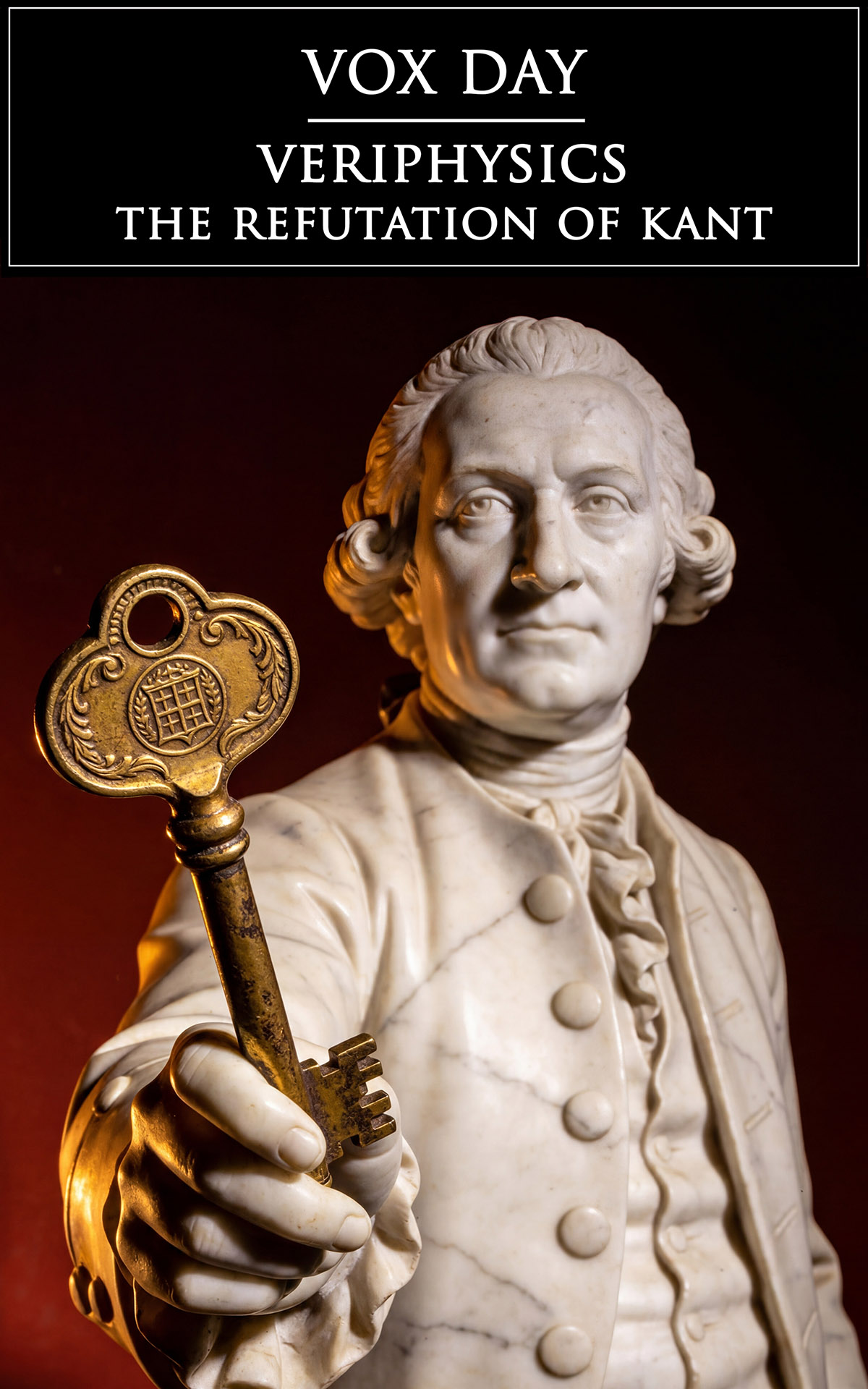
Veriphysics: The Refutation of Kant
by Vox Day
Book 2 of Veriphysics
From $9.99/month — 3 ebooks per month
 Français
About this book
Veriphysics: The Refutation of Kant: The Failure of the Modern Foundation and the Key to the Closed Door
The Enlightenment promised to liberate the mind. Instead, it locked reason inside a philosophical room and declared everything outside that room to be unknowable. But the door was never locked. Immanuel Kant published The Critique of Pure Reason in 1781. For 245 years, the intellectual framework he constructed has determined how the modern world thinks about knowledge, science, morality, and reality itself.
Every educated individual in the West has absorbed Kant's philosophical restrictions without knowing it. This includes the belief that science is the only reliable source of knowledge, the assumption that facts and values occupy separate domains, the conviction that consciousness is an unsolvable mystery, the idea that free will is an illusion, and the conceit that reality as it truly is lies permanently beyond the reach of the human mind.
But the door was never locked. The key was available all along. Yet no one ever tried to leave the room because Kant convinced the entire Western intellectual tradition that there was no exit.
Veriphysics: The Refutation of Kant demonstrates that the foundation of Kant’s The Critique of Pure Reason rests upon a logical fallacy that Kant himself recognized. His conclusion about unknowability of reality was never argued or justified. It was merely assumed, and two and a half centuries of Kantian commentary failed to notice this or understand the implications. Furthermore, the philosophy of mathematics upon which Kant's system depends has been contradicted by later developments in the field. And this critical architecture cannot be repaired. The door to knowability he shut is no longer closed.
- Published
- June 1, 2026